
Articles written appear in the order of published date: ForeSer; The voice of the people – the Angela Peralta choir; Pedregoso: a wacky, winding street with personality plus; Artists under pressure;
FloreSer – a safe home for teenage girls who have been victims of abuse and violence.
By Sheila Madsen, March 2022
FloreSer is unique to Mazatlan; there is no other organization that helps at-risk girls in all of Sinaloa. It’s impossible to gather the correct data on violence and domestic abuse that occurs every single minute of the day in Sinaloa, but it’s a high number. So large it would break your heart.
The purpose of this article is to shine a huge light on the organization that stepped up in 2008 to house and help girls between the ages of 9 to 17 years old. Their mission is to provide the girls with a home where they feel safe and can grow with their dignity intact. Lucila Magaña Valdez is the director and her sisters were former directors; she’s not new to FloreSer and knows the growing pains. It started with a generous Mexican family donating a big house for the purpose of providing a safe haven for girls needing to escape their abusive environment.
Neighbours would call when they witnessed a family abusing a young girl, relatives would call, concerned citizens would call. At first, FloreSer would take them in but quickly realized there needed to be a formalized evaluation process. The volunteers couldn’t deal with emotionally disturbed girls, pregnant girls or violent girls. It became clear that taking girls, any girl, was not providing the safe haven they imagined.

The director and volunteers, especially a long-time volunteer Nancy Dietrich, approached DIF, Desarollo Integral de la Family, a well -established federal organization dedicated to helping the poor, the disabled and families in need. DIF in Mazatlan has always played an important role and they offered to evaluate the girls so that FloreSer could indeed become the safe home they had envisioned.
DIF ensures that each girl is assessed, and if they are on drugs, or have severe emotional problems that require regular medication [FloreSer has no nurses on staff] then they are placed in a more suitable environment. After a lengthy screening process the girls that arrive at Floreser need exactly what you’d think they need: food, clothing, bathrooms, personal supplies, mentors, tutors, counsellors, psychologists, chaperones, laptops, regular school, tv, games – all necessary to recover their dignity and self-esteem. In Spanish ForeSer means “to bloom.”
 Currently Floreser is a full house with 12 girls, however since 2008 over 400 girls have stayed in this safe haven and have found a family or friend who will continue to keep them safe. Some stay for four years, some six months, many look for other relatives and leave. FloreSer is not a jail, it’s a safe home and they can return at any time. If a girl can’t read or write, then a tutor will bring them up to the right level, so they can attend a normal school. In some cases one-on-one tutoring has proved to be very successful to girls who are three years behind – they can catch up in just one year! Today, 10 out of the 12 girls are attending public schools; they come home after school and learn to cook, or take sewing lessons from another long-time volunteer, Heather Wanless.
Nancy shared two emotional success stories. One day she was shopping at Liverpool and saw a young woman she recognized. It was a FloreSer girl, grown up, working now and paying her way. They both smiled and moved on with their day. Another FloreSer girl, studied, left, got a job, married and at Christmas she arrived at the FloreSer home with $1,500. She said “you saved me, and I’ve been saving for years to help FloreSer so you can save other young girls.”
At 18 they can decide to stay and study or work, or both. Most choose to leave and carve out a new life but for those who wish to remain and study, FloreSer will continue to support their goals.
Support. Yes, it’s vital that you know that FloreSer receives no money from the government – city, state or federal. The tireless volunteers and staff raise money through various annual fundraisers. In the beginning, I mentioned a large house was donated, true, but now the house needs massive repairs and a big injection of pesos. Perhaps the next time you read about a FloreSer fundraiser you’ll think about 12 young girls who have been given a second chance, who are now leading a safe and violence-free life. Who are blooming. To quote FloreSer: “our success depends on your continued help. Every act of generousity no matter what size, makes a difference. Your generosity changes lives.”
[Visit https://floreseriap.com Donate via PayPal or through Kapital [was Intercam], or go the FloreSer house on Rio Quelite #812 [just behind Lola Beltran] – gated with a buzzer. If you wish to donate – either money, an outing such as a pizza party, clothes, an afternoon at the beach, a morning spa treatment, please call Kathy Muñoz Vega at 669 229 7464 from Monday to Saturday, 10 am until 2 pm. – she’s the social worker, speaks English, and knows the girls’ school schedules. The volunteers are happy to pick up your donation and give you receipt, a factura, as FloreSere is a registered charity and your donation is tax deductible.. Francisca Genoveva Valencia Bernal is the director of FloreSer. Ivonne del Carmen Martinez Ramirez is the psychologist.Dra. Maria Teresa Apodaca de Gonzala is the director of DIF.]

The voice of the people – the Angela Peralta choir.
By Maaike Hoekstra, February 2019, proud choir member [left in the picture below] plus the owner and founder of Flavor Teller – Mazatlan’s original street food tour.
If you would ask me what has helped me most to integrate in Mazatlan’s society, my answer would probably surprise you. Want to know where I learned the Mexican anthem and ‘Las mañanitas’ (Mexico’s happy birthday song) and the local banda anthem ‘El Sinaloense’? Want to know why I know so many people in town? Want to know where I go for stress relief? Want to know where I found my inner actress? It’s all the same place: the Angela Peralta choir.
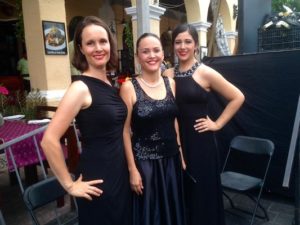 The Angela Peralta choir was founded in 1992 by Maestro Antonio Gonzalez. He is an accomplished pianist and he founded another community choir in Coatzacoalcos, Veracruz before settling in Mazatlan. The Angela Peralta choir is one of the pillars of the local cultural scene, together with the classical ballet, Delfos Modern Dance Company and the Fine Arts music school. Each of these cultural groups were founded before or shortly after the remodeling of the Angela Peralta theater in 1992. The Angela Peralta choir has been the cradle for successful singers who have built their careers outside Mazatlan like Adan Perez (New York), Carlos Osuna (Vienna), Armando Piña (Philadelphia), Penelope Luna (Mexico City) and Eimy Osuna (Mexico City).
 Why join a choir?
I’ve been asked this question many times. With almost no choir experience and a limited music education, it seemed daunting at first to sign up for this prestigious vocal group. However, there is no requirement for aspiring members apart of interest in singing. There is a short audition to see which voice you are (soprano, mezzosoprano, tenor or baritone) and you’re ready to go. Mostly we know several months in advance when our next performance is. Sheet music is handed out and the tough work starts. There are new choir members that have no previous knowledge of reading sheet music so at the beginning of the season a speed course is offered.
A community choir is a bit like a human body, each voice performs a different task but they can’t function without each other. The sopranos are the drama queens, singing too loudly and always wanting to be the center of attention. The mezzo-sopranos (or altos) are having beautiful voices, if you only could hear them. The tenors are always a little bit distracted and the baritones and basses just fell asleep (zzzzz….). It might seem like an exaggeration, but after being part of the Angel Peralta choir for more than a decade there’s truth in it.
 There are tedious rehearsals deciphering melodies and tempos, there’s chewing your way through foreign languages (ever tried to sing in Russian?), there is sharing sheet music because you forgot to bring that specific piece. But bit by bit, like a puzzle, separate parts come together and the spark of vocal harmony lights up the room. Then you have to polish the details: the quiet pianissimos, and thunderous fortes, the sharp staccato and dreamy andante. Finally, the count-down for the concert comes to an end and you enter ground zero: the performance hall. It might be the humblest podium in a poor neighborhood or the grand stage of the Angela Peralta Theater. Lengthy last days rehearsals mix with make-up sessions, behind the scenes chit-chat over coffee (and cookies if you’re quick), costume fittings, squeezing 80+ people on an ever-too-small platform, sore legs from standing up too long. At times you wonder: why did I sign up for this? But then you hear: “Tercera llamada… Comenzamos!” (Third call…we begin). An adrenalin rush flows through your veins, the curtains slide open, the lights flash on and it’s SHOWTIME!
What would be the highlight of my choir career? After 13 years there are many things to choose from: singing monumental chorale concerts like the Carl Orff’s Carmina Burana, Mozart’s Requiem or Berlioz’s Te Deum are a physical, mental and team-work challenge. Participating in operas like Bizet’s Carmen and working with local opera guru Maestro Enrique Patron de Rueda, has a charm of its own. Having to sing and act on stage is a wonderful enriching experience.
Most importantly what I’ve gained after all these years, are the friendships. Who else would have thrown me a baby-shower including floral corsage and diaper games? Who else would have helped me out when I was stuck in a bureaucratic mess? This is why I proudly call myself a member of Mazatlan’s Angela Peralta choir!
[Interested in joining? Contact Mari Murillo on the Coro Angela Peralta – 25 años Facebook page for more information. The choir rehearses on Mondays, Wednesdays and Friday from 7-9 p.m. at the Fine Arts school next to the Angela Peralta Theater. Rehearsals may be more often if a concert is coming up. While you are a volunteer you pay a small inscription and monthly fee]
Pedregoso: a wacky, winding street with personality plus
By Sheila Madsen (February 2013)
When you are two there are so many decisions to agree upon. Children, cat, dog, parrot, downtown, suburbs, condo, garden, squash, tennis, travel, stay, meat, vegetarian, organic, spend, save, eat in, dine out and the daily dialogues go on and on. For most of us who decide to move to Mazatlan, because of our age, the debates do become smaller. Something like this: view, no view, in Centro, out of Centro, to buy, to rent, house, apartment or condo? We knew within five days we wanted to live in Centro, and to buy a condo with a view.
While we waited two years for our condo, Vue Centro Historico to be built, we lived on the wacky, winding street of Pedregoso. Pedregoso has its ups and downs. Literally. It runs parallel to Angel Flores, but due to nature of the topography, namely a huge hill, it offers amazing views. The second floor of Pepe’s new apartment (he has since expanded and I refer to it as “Pepe’s Pedregoso Palace”, sadly Pepe died in November 2024 but his wife Georgina carries on.) had most of our requirements. I won’t dwell on the deficits, but the assets were the location and the view. Four years ago we’d watch the surfers on Olas Altas, and a guy training his dog to surf. The dog became quite the surfer and knew exactly when to turn back to shore.
We always enjoyed watching the cruise ships glide in and out. But those ships have sailed. Often we’d climb up to the roof, very carefully, with our wine, and watch the sunset then star gaze. Waking up, we’d see the sun rise over the cathedral. Then there were the Pedregoso cast of characters. Poncho lived next door and did odd jobs and had odd hobbies. He changed his outfits three times a day and went from brown pigtails to a blond Mohawk. Susan Carnes was busy installing beautiful paintings in her windows. Angela Jackson had a lovely morning yoga practice on her roof. Sylvia, the talented seamstress in the peppermint green house, made me seven dresses. She still sews for me, as my shape is changing- probably because I am not walking up and down Pedregoso any more. Conchita would whip up a batch of tamales and we’d all traipse through her tiny kitchen to buy the sweet pineapple ones. She has since died. Patty Neal left Pedregoso when her husband died, tried different cities and has now returned “home” to Pedregoso. Bob and Diane would arrive from Canada and put a spring in our step. They walk up to El Faro every morning and are an inspiration.
Mexicans, Americans, and Canadians would all gather in Joaquin’s tienda and buy one egg, one cigarette, one onion; it’s a store for every one. Lourdes takes the morning shift in stilettos, tight jeans (and a lovely cleavage) and buyers stream in for their morning munchies. Joaquin’s wife, Gerenia, manages the afternoon shift, and the two daughters assist in the evening. No need to purchase a newspaper; you heard it all there. After two years we knew every single house, almost every single person, every single dog (and strays), and every annoying rooster. The street of Pedregoso is a community.
For twenty years, the Old Mazatlan Inn has been the king of the hill. Long term renters were always friendly and would ask us in for a swim, or to watch the sunset. Short term renters gasping for breath at the top of the hill, would remark how the “trek” was worth it and how they wanted to get in shape. The manager, O’Neil, never failed to give us a ride or to extend a welcoming invitation to us. We called it the “OMI”(Old Mazatlan Inn) and the feeling was always friendly and hospitable.

O’Neil Patrick McGean
1964-2016
This past week we decided to vacate our condo on Passeo Claussen, with all the music from Carnaval, and walk to Pedregoso and spend the nights at the OMI. Nothing has changed, just improvements. It’s super clean, the drinking water is filtered, there’s Wi-Fi, the pool is immaculate, the gardens lush and from the top roof you have a breathtaking wrap around view. There is not another view like it in Centro, not even close. Immediately you feel at home, relaxed, and it’s just the right place to be.
I forgot. One thing has changed. The OMI is going condo. If we had known that four years ago…but we didn’t and hindsight is a waste of time. So if you want to rent, to buy, and have a view to live for in Centro, Pedregoso is your street, and just perhaps Old Mazatlan Condominiums is your place. This is an opportunity to rent, while you think about buying. It’s a combination we would have embraced four years ago. But it wasn’t available, and we will always have Pedregoso. 
Artists under pressure – Mazatlan’s first ever street printing event, was on October 26,27,28, 2012.
By Sheila Madsen ( July, 2012) 
It takes a village to make a steamroller print. Leading this huge project are Glen Rogers director of Luna arte Contemporáneo, and Cecilia Sánchez Duarte representing the CMA – Centro Municipal de Artes. Starring in “artists under pressure” are ten artists from Luna and ten guest artists from CMA. Have no idea of what a steamroller print is? You are not alone. The Chinese invented paper around 105 AD. They carved images into stones, covered them in a dye and rubbed them into the handmade paper. Woodblock printing emerged in about 868 AD. Six hundred years later woodblock printing arrived in Europe. The process is: take a block of wood, carve out the design you want to appear in white, the remaining flat surface, when covered in ink, will print in black. It’s like looking at a negative. The carving is then pressed onto fabric, or paper. The invention of the printing press in 1440 did not hinder the art or production of woodblock carvings. In every century, artists are drawn to this rustic expression.

Fiat assists Nan Robb with her wood cutting.
The star of this show rolls into the world in 1910; the steamroller. Horses were put out to pasture and the roller now powered by steam is used to compress the asphalt surface. Eventually steam evaporated and was replaced by the internal combustion engine. Artists were still carving their woodblocks, papermaking had evolved to large sheets, and steamrollers were everywhere flattening the roads across North America. Someone was thinking big picture when they got the idea to put these ingredients together and create massive woodblock prints. Meanwhile back in Mazatlan, Glen and Cecilia are busy coordinating 20 artists. Currently the plywood has been purchased and artists are digging in and carving their images. Artists have been asked to create images in honour of the Day of Dead, Dia de los Muertos.(José Guadalupe Posada is the Mexican artist responsible for these iconic images and they stemmed from his satirizing the upper classes as dandies, which explains the extreme elegance of the clothes on the Catrina drawings.
Since his death in 1913, his images have become associated with Dia de los Muertos.) On the weekend of Oct. 26,27, 28, “artists under pressure” will come alive from 10 a.m. until 4 p.m. on Aurora, between Niños Héroes and Belisario Dominguez. You’ll be able to see the artist place her inked canvas of wood on the street, while the team prudently lowers the 3 x 4 foot sheet of paper onto the plywood, and then that paper is protected by a thick blanket. The two ton steamroller slowly runs over, pressing the image onto the paper. The group carefully lifts up the wet black inked paper and hangs it out to dry. The same process will be repeated on fabric for banners in the Dia de los Muertos Procession on November 1. It does take a village to create these “roadworks.” MazatlanLifeTV will be filming the creative process during the fall; stay on this page for the uncensored video of “artists under pressure.”
Participating Artists :Rubio Gallery -Manuel Alancaster,Manuel Carlock,Cecilia García Morales, Jorge LuisHurtado,Luis Kano,Alejandro Mojica,Blas Nayar,Dory Perdomo,Cecilia Sánchez Duarte,Gerardo Santamarina. Luna Gallery –Ken Augustine, Rafael Avila, Elina Chauvet, Pablo Corpus, Kathleen Baker Pittman, David Robb, Nan Robb, Glen Rogers, Lucila Santiago, Arturo de la Vega. The gala presentation of the steamroller woodblock prints takes place at Luna on Wednesday October 31 from 6 p.m. to 8 p.m. Steamroller prints in Mazatlan – it’s a first and you don’t want to miss it.